
The edge profile of your worktop is far more than just a finishing touch – it’s a defining feature of your kitchen’s character. We often find that while clients meticulously choose their stone, the nuances of edge profiles can be a bit of a mystery. That’s why we’ve crafted this guide, taking you beyond the surface to explore the origins, history, fascinating details, and practical considerations of the custom worktop edges we meticulously fabricate every day.
We aim to empower you with a deeper understanding, helping you appreciate the story behind each curve and angle. From the sleek lines of contemporary designs to the intricate details of classic forms, we’ll delve into how these profiles came to be, what makes them unique from a craftsman’s perspective, and how they can enhance your space. So, let’s embark on this journey together, exploring the art and science of worktop edges.
Understanding Worktop Edge Profiles: A Craftsman’s Perspective
Before we explore the specific styles, allow us to share a little about what these profiles represent from our workshop floor.
What is a Worktop Edge Profile? An edge profile is where our artistry directly meets the raw power of the stone. It’s the intentional shaping and meticulous finishing of a worktop’s exposed edges. After your chosen granite or quartz slab is precision-cut, we employ a combination of advanced machinery and time-honoured hand-crafting techniques. This isn’t merely about smoothing a sawn edge; it’s about sculpting the stone to achieve a specific aesthetic and functional result, a process that requires both technical skill and an eye for detail.

Why is the Edge Profile So Important? We see firsthand how the edge profile transforms a slab of stone into a bespoke piece of functional art. Here’s why it’s a critical decision:
- Defining Aesthetics: The edge is a primary visual cue. A simple eased edge might whisper quiet sophistication, while a grand Ogee can make a bold, classical statement. We help you match the edge to your kitchen’s narrative.
- Tactile Experience & Functionality: How does the edge feel to the touch? Is it rounded and forgiving, or crisp and defined? Some profiles, like a Demi Bullnose, are cleverly designed to guide spills away from your cabinetry – a small detail with big practical benefits. For families, a softer, more rounded edge is a practical safety consideration we often discuss.
- Showcasing the Stone & Craftsmanship: A well-chosen and expertly executed edge profile can highlight the natural beauty, depth, and thickness of the stone.
- Durability and Longevity: While materials like granite and quartz are incredibly tough, the edge design can affect its resilience to accidental knocks. Rounded profiles, for instance, tend to be more forgiving of impacts.
- Investment Value: The pricing is relative to the complexity of an edge profile, reflecting the time, skill, and specialised tooling. While simpler edges are more economical, a more elaborate profile can add a distinct touch of luxury and perceived value to your kitchen.
Exploring Popular Worktop Edge Profiles: A Deep Dive
Now, let’s delve into the nine most common edge profiles, exploring their heritage, unique characteristics, and the insights we’ve gained from crafting them over the years.
1. Single Pencil Edge: The Essence of Understated Elegance

The Single Pencil edge, also known in the trade as a “pencil round” or “eased edge,” features a subtly rounded top edge. Imagine the gentle curve of a classic wooden pencil – that’s the typical radius, usually between 3mm to 6mm. The bottom edge is often kept square or might have a minimal chamfer (a tiny 45-degree angle) to prevent sharpness. It’s the epitome of “less is more.”
Origins & History: This profile is a natural evolution from the basic chamfered edge. As stone fabrication techniques advanced beyond simple hand-hewing, the ability to slightly soften edges for comfort and chip resistance became desirable. It doesn’t have a grand historical point of origin but rather represents a fundamental refinement in stoneworking, becoming ubiquitous with the rise of more precise cutting and polishing tools in the 20th century. It’s a practical response to the need for a clean, safe, and unobtrusive finish.
A Stonemason’s Insight: From our perspective, the Single Pencil is a mark of quiet precision. While seemingly simple, achieving a perfectly consistent radius along the entire length of a worktop, especially on harder stones, requires careful calibration and a keen eye during polishing. It’s living proof that even the simplest forms demand skill. We often recommend it for its sheer versatility and its ability to let the stone itself be the star.
- Technical Detail: The top arris (the sharp edge of the stone) is ground down using progressively finer diamond abrasive pads on a handheld polisher to create that small, uniform radius. The key is consistency in pressure and movement.
- Look & Feel: It offers a clean, crisp, and contemporary aesthetic without the harshness of a completely square edge. It feels smooth to the touch on top.
- Best Suited For: Its versatility is its strength. It’s a natural fit for modern, minimalist, and transitional kitchen styles. We’ve also seen it used effectively in Scandinavian designs and even some industrial-chic spaces where the focus is on raw materials and clean lines.
- Pros:
- Cost-Effective: Being one of the simplest profiles to create, it’s generally one of the the more budget-friendly options.
- Easy to Clean: The smooth, slight curve doesn’t trap dirt.
- Timeless & Unobtrusive: It doesn’t compete with other design elements and is unlikely to look dated.
- Improved Safety: That slight rounding significantly reduces the sharpness compared to a squared edge, offering a degree of chip resistance and safety.
- Cons:
- Subtlety: If you’re looking for a statement edge, this isn’t it. It can feel too plain for ornate or very traditional kitchens.
- Still Angular: While softened, the overall profile retains a degree of angularity, especially with the square bottom edge.
2. Double Pencil Edge: Symmetrical Softness

The Double Pencil edge extends the gentle rounding of the Single Pencil to both the top and bottom edges of the worktop. This creates a symmetrical, subtly softened profile.
Origins & History: Similar to the Single Pencil, the Double Pencil is a product of evolving fabrication capabilities and a desire for a more finished, less utilitarian look. It likely became more common as stonemasons sought to provide a completely softened edge, particularly for surfaces like island overhangs or breakfast bars where both top and bottom edges are more exposed and accessible. It represents a further step in refining the basic square form.
A Stonemason’s Insight: Crafting a Double Pencil requires a bit more attention to ensure the radii on both top and bottom are perfectly matched and symmetrical. It’s about balance. When we fabricate this edge, especially for thicker worktops, it gives the stone a pleasingly tactile quality – it feels good to run your hand along it. It’s a subtle upgrade from the Single Pencil that many clients appreciate for its more complete look.
- Technical Detail: Both the top and bottom horizontal arrises are ground to an identical small radius (typically 3-6mm each).
- Look & Feel: It offers a slightly softer, more refined appearance than its single counterpart, while still preserving a clean, contemporary aesthetic. The symmetry adds a touch of quiet elegance.
- Best Suited For: Excellent for modern and transitional kitchens. It’s particularly effective on kitchen islands, peninsulas, and breakfast bars where the underside of the edge might be visible or frequently touched.
- Pros:
- Relatively Inexpensive: Still a cost-effective option, though slightly more than a Single Pencil due to the extra machining.
- Easy to Maintain: Smooth surfaces mean easy cleaning.
- Balanced Aesthetic: The symmetry is visually pleasing and feels more “finished.”
- Enhanced Chip Resistance: Softening both edges provides better protection against minor impacts from all angles.
- Cons:
- Minimalist Nature: Like the Single Pencil, it’s not a highly decorative choice and may not suit very traditional or ornate designs.
3. Single Chamfer Edge: A Stroke of Geometric Definition

A Single Chamfer (pronounced “sham-fer”) edge is distinguished by a straight, angled cut along the top edge of the worktop. This bevel is typically cut at a 45-degree angle, though custom angles are possible. The width of the chamfer can vary, from a discreet 3mm to a more noticeable 6mm or even 10mm, creating different visual impacts.
Origins & History: Chamfering has ancient roots in woodworking and architecture, used to remove sharp, vulnerable edges and to add visual interest. In stonework, it became more prevalent with the advent of precision cutting tools. The 45-degree angle is a practical and aesthetically pleasing choice, creating a look that is both clean and intentional. It speaks to a more architectural or engineered aesthetic than a simple rounded edge.
A Stonemason’s Insight: Achieving a crisp, perfectly straight chamfer with a consistent angle and width requires precision. For hand-finishing or blending, it demands a steady hand. A well-executed chamfer catches the light beautifully, adding subtle highlights to the worktop. We often suggest it to clients who want a modern look but with a bit more definition than a pencil edge. It’s also quite robust.
- Technical Detail: The top edge is ground down at a specific angle (usually 45 degrees) to create a flat, sloped surface. The width of this sloped surface is the ‘size’ of the chamfer.
- Look & Feel: It imparts a clean, geometric, and distinctly modern look. The angled facet adds a subtle architectural detail and a sense of precision.
- Best Suited For: Contemporary, industrial, and minimalist kitchen designs thrive with this edge. It can also lend a sophisticated touch to transitional styles, especially when paired with sleek cabinetry.
- Pros:
- Defined & Neat: Creates a very tidy, sharp (in appearance, not to touch) and defined line.
- Relatively Easy to Clean: The flat, angled surface is simple to wipe down.
- Good Chip Resistance: Removing the sharp 90-degree arris makes it less prone to chipping than an unprofiled square edge.
- Cost-Effective: Generally, it’s an affordable profile, similar in cost to pencil edges.
- Cons:
- Angular Feel: While not sharp, the distinct angle can still feel more “edgy” than rounded profiles, which might not suit all tastes or be ideal for high-traffic corners if very young children are a concern.
4. Double Chamfer Edge: Symmetrical & Sophisticated Bevels

The Double Chamfer edge mirrors the angled cut on both the top and bottom edges of the worktop. This creates a symmetrical, bevelled appearance that adds a sense of substance and tailored design.
Origins & History: Like the Single Chamfer, the Double Chamfer draws from classical woodworking and architectural detailing where bevels were used to create visual interest and reduce the perceived mass of an element. In stonework, it offers a more complete and often more formal look than a single chamfer, suggesting a higher level of finish and attention to detail. It became more popular as stone fabrication techniques and tooling allowed for consistent and precise machining of multiple facets.
A Stonemason’s Insight: The Double Chamfer is a favourite of ours for thicker worktops (30mm or more) as it really accentuates the depth of the stone without looking too heavy. The key is ensuring both chamfers are identical in angle and width for perfect symmetry. It’s a profile that feels solid and looks particularly good on stones with interesting internal patterns, as the facets can catch the light and reveal different aspects of the material.
- Technical Detail: Both the top and bottom edges are ground at an angle (typically 45 degrees), resulting in two flat, sloped surfaces that meet the vertical face of the worktop. Precision is key to ensure the facets are crisp and symmetrical.
- Look & Feel: It offers a more substantial and sophisticated geometric look compared to the Single Chamfer. The symmetrical bevels give it a tailored, crisp, and almost jewel-like finish.
- Best Suited For: Modern, contemporary designs, and can even lend itself to some Art Deco or industrial-inspired kitchens. It’s excellent for adding strong definition, especially to thicker worktop slabs or feature pieces like kitchen islands.
- Pros:
- Strong Visual Definition: The double bevel creates a striking, architectural aesthetic.
- Enhanced Durability: By removing both sharp 90-degree arrises, it’s very resistant to chipping.
- Symmetrical Appeal: The balance of the top and bottom chamfers is visually satisfying and looks highly finished.
- Cons:
- Higher Cost: Requires more work than single chamfer or pencil edges, so it’s typically a step up in price.
- Distinct Corners: While not sharp, the defined angles are more pronounced than on rounded profiles.
5. Bullnose Edge: The Enduring Classic Curve

The Bullnose edge is a true classic, instantly recognisable by its fully rounded edge that forms a perfect half-circle (a 180-degree convex curve) from the top surface down to the bottom surface of the worktop.
Origins & History: The Bullnose has a long and distinguished history in architecture and design, seen in everything from ancient Roman stonework (think rounded column bases or stone steps) to Victorian furniture. In worktops, it became popular for its soft appearance and inherent safety. It’s a timeless profile that speaks of traditional craftsmanship and enduring style.
A Stonemason’s Insight: Creating a perfectly consistent Bullnose, especially on a thick piece of granite, is a demanding, yet satisfying process. It requires multiple passes with progressively shaped diamond tooling to achieve that smooth, flowing curve. The challenge lies in maintaining the exact semi-circular profile without any flat spots. A well-made Bullnose feels wonderfully smooth and is incredibly robust. It’s often chosen for its child-friendly nature, a point we always highlight to families.
- Technical Detail: The entire edge is ground into a smooth, convex semi-circular shape. The radius of this curve is precisely half the thickness of the worktop (e.g., a 30mm worktop would have a Bullnose with a 15mm radius).
- Look & Feel: Soft, gentle, traditional, and timeless. It eliminates all sharpness, creating a very smooth, flowing, and welcoming appearance.
- Best Suited For: A natural choice for traditional, country, farmhouse, and classic kitchen styles. Its inherent safety also makes it a top pick for family kitchens.
- Pros:
- Ultimate Safety: With no sharp points whatsoever, it’s the safest edge profile, ideal for homes with young children or for those who prefer a softer touch.
- Classic, Enduring Appeal: It’s a style that never truly fades and complements traditional aesthetics beautifully.
- Easy to Clean: The continuous curve has no crevices to trap dirt.
- Highly Durable: The rounded edge is excellent at deflecting impacts, making it very resistant to chipping.
- Cons:
- Spill Management: Liquids can sometimes follow the curve and drip down onto cabinet fronts more readily than with edges that have a slight undercut or sharper bottom return (like a Demi Bullnose).
- Perceived Style: Some might view it as too traditional for very sleek, modern minimalist settings, though it can be used to soften contemporary designs if desired.
6. Demi Bullnose Edge (Half Bullnose): The Versatile Modern Curve

The Demi Bullnose, often called a Half Bullnose, offers a softer look with a modern sensibility. It features a rounded top edge, much like the Bullnose, but this curve transitions into a flat, square bottom edge.
Origins & History: It evolved as a popular compromise between the full roundness of the Bullnose and the crispness of a square or pencil edge. It retains the softness on the top, most contacted surface, while the flatter bottom provides a cleaner line and, crucially, can act as a drip edge, helping to guide spills away from cabinet doors. It gained popularity in the late 20th century as kitchen designs began to blend traditional comfort with more contemporary lines.
A Stonemason’s Insight: It’s one of the most frequently requested profiles in our workshop, and for good reason – it’s incredibly versatile. The key to a good Demi is a smooth, flowing top curve that transitions seamlessly into the flat vertical face, with a crisp bottom edge. This profile is also quite efficient to produce, making it a good value proposition for its aesthetic appeal. We often point out its practical benefit in spill management.
- Technical Detail: The top edge is ground into a pronounced curve (typically a 90-degree radius that flows smoothly into the vertical front face of the worktop), while the bottom edge remains straight and square.
- Look & Feel: It’s softer and more inviting than a pencil or chamfered edge but looks more contemporary and less “heavy” than a full Bullnose. It strikes an excellent balance.
- Best Suited For: A true all-rounder, it’s perfectly at home in transitional, contemporary, and many classic kitchens. Its widespread appeal makes it a safe yet stylish choice.
- Pros:
- Soft & Safe Top Edge: Offers comfort and reduces the risk of injury from the most commonly contacted part of the edge.
- Subtle Drip Edge: The flat bottom edge helps prevent spills from easily rolling under and onto cabinet doors and drawers.
- Easy to Clean: The smooth top curve is simple to maintain.
- Broad Appeal & Versatility: Complements a vast range of kitchen styles and material choices.
- Cons:
- Square Bottom Edge: While the top is rounded, the bottom edge is still square, so it doesn’t offer the complete “softness” of a full Bullnose if that’s a primary concern.
7. Ogee Edge: The Epitome of Ornate Elegance

The Ogee edge is arguably the most decorative and recognisable of the classic profiles. It’s characterised by a distinctive “S”-shaped curve – typically a concave curve (inward) flowing smoothly into a convex curve (outward).
Origins & History: The Ogee (or “cyma recta/reversa” in classical architectural terms) is a truly ancient decorative moulding, with roots in Greek and Roman architecture. It was heavily featured in Gothic architecture and saw a major resurgence during the Renaissance, Baroque, and Victorian eras in furniture design, cabinetry, and, of course, stonework. Its name is thought to derive from “Old French” ogive, referring to a pointed arch, though the S-curve is its defining feature. It has always signified luxury, craftsmanship, and a high degree of ornamentation.
A Stonemason’s Insight: Crafting an Ogee edge is a true test of a stonemason’s skill and the capabilities of our machinery. It requires multiple, precisely shaped diamond tools to form the intricate S-curve. The transitions between the concave and convex sections must be flawless. It’s a labour-intensive profile, which is reflected in its cost, but the result is undeniably spectacular. An Ogee edge transforms a worktop into a statement piece. We take particular pride in the crispness and flow of our Ogee profiles.
- Technical Detail: This profile involves grinding two distinct but interconnected curves into the stone edge. The precision required to make these curves flow perfectly and maintain their definition is significant.
- Look & Feel: Elegant, formal, luxurious, and highly traditional. It adds a significant decorative flourish and a sense of grandeur.
- Best Suited For: Traditional, classic, Victorian, Edwardian, and French country kitchen styles. It’s often the go-to choice for creating a focal point, especially on kitchen islands or in more formal kitchen settings.
- Pros:
- Highly Decorative & Visually Striking: Makes an immediate and impactful design statement.
- Adds Luxury & Sophistication: Instantly elevates the perceived value and opulence of the worktops and the kitchen.
- Timeless Traditional Appeal: It’s a classic that remains sought after for high-end traditional designs.
- Cons:
- Premium Cost: Due to its complexity, it’s one of the most expensive edge profiles.
- Cleaning Challenge: The grooves and curves can be more prone to trapping dust, crumbs, or food particles and require more diligent cleaning.
- Style Specificity: It can look out of place or overly fussy in very modern, minimalist, or utilitarian kitchen designs.
8. Scotia Edge: Graceful, Subtle Indentation

The Scotia edge is a contemporary profile delivering a strong, architectural line combined with a smooth, rounded face. It begins with the flat, horizontal top surface, which drops sharply via a short, straight vertical step (fillet). Immediately from the base of this step, the edge sweeps outwards in a full convex curve, rounding down smoothly to meet the vertical base of the worktop.
Origins & History: A distinctly 21st-century design, the Scotia edge emerged as a (fictional) response from European designers seeking an edge with clear definition but without the complexity of traditional S-curves. It represents a modern reinterpretation of stepped profiles.
A Stonemason’s Insight: The appeal of the Scotia lies in its clean precision. The critical element during fabrication is achieving a perfectly crisp, 90-degree transition between the top surface, the vertical step, and the start of the convex curve. This sharp definition at the top, combined with the smooth, uninterrupted roundness of the main edge, requires careful tooling. It’s a visually striking profile that feels solid and modern, offering a defined shadow line and a pleasant, rounded touch.
- Technical Detail: Following the flat top, a precise vertical step (fillet) is cut downwards. Directly from the bottom edge of this step, a consistent convex radius is ground outwards and downwards, typically forming a half-circle (180-degree) curve, until it flows seamlessly into the main vertical slab face.
- Look & Feel: Modern, defined, and substantial. It offers a clean, architectural look thanks to the step, but the full convex curve provides a soft, approachable, and ergonomic feel. It’s less ornate than an Ogee or Scotia (as we defined it) but more detailed than a simple Bullnose or Eased edge.
- Best Suited For: Contemporary, modern, and transitional kitchens or bathrooms. It’s an excellent match for flat-panel cabinetry, minimalist designs, or anywhere a clean, defined edge is desired without sharpness. It works well to emphasize the thickness and solidity of a worktop.
- Pros:
- Unique & Refined Aesthetic: Offers a distinctive look that is both graceful and sophisticated.
- Softer Appearance: Provides a more distinctive edge than rounded or chamfered profiles.
- Versatile Elegance: Can bridge the gap between modern simplicity and traditional detailing.
- Cons:
- Potential for Trapping Debris: The step, if not wiped regularly, could potentially collect crumbs or spills more easily than a flat or convex profile.
- Slightly Higher Cost: Generally pricier than basic pencil or chamfer edges due to the more involved shaping.
9. Sharks Nose Edge (Plovdiv, Arris): The Illusion of Sleek Modernity
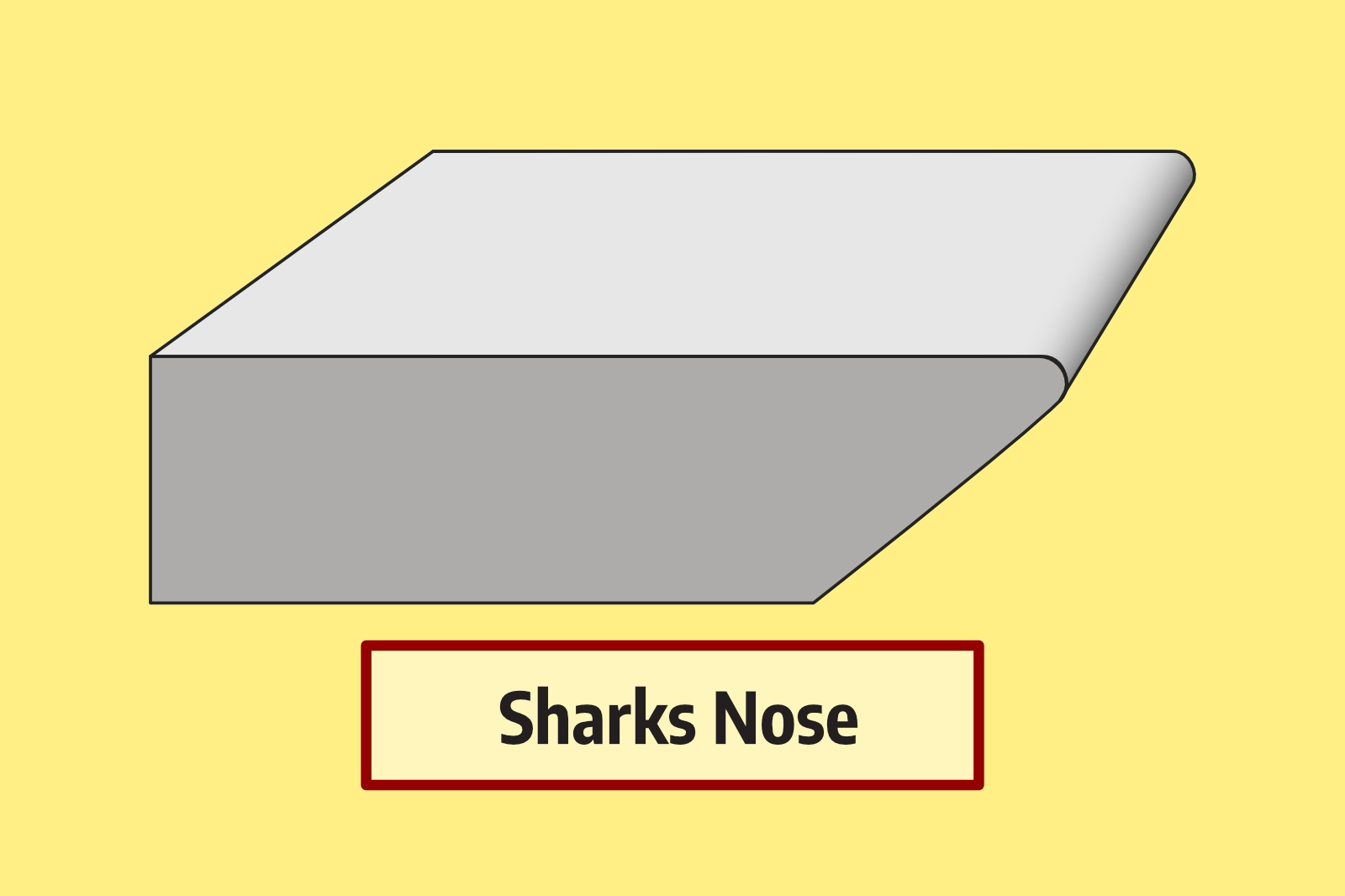
The Sharks Nose edge – also known in the industry by regional names like Plovdiv, Arris, or sometimes as a type of “reverse bevel” or “undercut edge” – is a strikingly modern profile. Its defining characteristic is that the underside of the worktop edge is angled sharply inwards (away from the front), creating the illusion that the worktop is much thinner than it actually is and appears to be almost floating above the cabinetry.
Origins & History: This is a more contemporary innovation in edge profiling, gaining significant popularity in the late 20th and early 21st centuries with the rise of minimalist and modern kitchen design. It’s a design born from a desire for clean, sharp lines and a visually lighter aesthetic. The “floating” look it achieves is highly sought after in high-end contemporary architecture and interior design. The name “Sharks Nose” vividly describes its sleek, tapering, and somewhat predatory profile.
A Stonemason’s Insight: The Sharks Nose is a feat of precision engineering in stone. Fabricating this edge, especially the acute angle on the underside, requires highly accurate stonemasonry. The top edge is very minimally eased to maintain that sharp, contemporary look. It’s a profile that demands perfection, as any inconsistency in the angle or line would be immediately noticeable. When executed well, it’s incredibly impactful and is a favourite for designers looking to make a bold, modern statement. It can also cleverly provide a “finger pull” for handleless cabinetry.
- Technical Detail: The bottom edge of the worktop is cut away at a steep angle (often 45 degrees or even more acute, like 60 degrees), tapering inwards towards the underside of the slab. The top edge is typically left rounded with a minimal arris relief (a tiny breaking of the sharp edge).
- Look & Feel: Ultra-modern, exceptionally sleek, and sophisticated. It creates a sharp, clean horizon line and a visually lighter, almost “floating” appearance for the worktop.
- Best Suited For: Contemporary, minimalist, and high-end modern kitchen designs. It’s particularly effective on kitchen islands, breakfast bars, and in handleless kitchen designs where the undercut can serve as a discreet way to open doors and drawers.
- Pros:
- Striking “Floating” Effect: Creates a dramatic, high-design aesthetic that makes the worktop appear thinner and lighter.
- Ultra-Modern Appeal: The epitome of sleek, contemporary design.
- Functional for Handleless Designs: The undercut can provide a natural finger pull, enhancing a minimalist look.
- Cons:
- Premium Cost: One of the more expensive profiles due to the complex and precise craftsmanship required, especially on the underside.
- Less Comfortable to Lean On: The sharply angled underside might be less comfortable to lean against for extended periods compared to a rounded or flat-fronted edge.
How to Choose the Right Worktop Edge Profile: A Stonemason’s Advice
View this post on Instagram
As your stonemasons, we guide clients through this selection process daily. Here’s what we advise you to consider:
1. Harmonising with Your Kitchen’s Style
The edge profile of your worktop should complement the established style of your kitchen. Here is a guide to suitable edge profiles for common kitchen design aesthetics:
Modern & Minimalist Kitchens
These styles prioritise clean lines and simple forms. Recommended edge profiles include:
- Single Pencil & Double Pencil: Offer a subtle, rounded finish.
- Single Chamfer & Double Chamfer: Provide a neat, angled look.
- Shark’s Nose: Creates a sleek, ‘floating’ effect.
Traditional & Classic Kitchens
Characterised by ornate details and a sense of history, these kitchens often benefit from more decorative profiles:
- Bullnose: A fully rounded edge, offering a soft, classic feel.
- Ogee: Features an ‘S’-shaped curve for a more elaborate look.
- Demi Bullnose: A partially rounded top edge, combining softness with a flat bottom for a slightly more contemporary take on a classic.
Transitional Kitchens
Blending elements of both traditional and modern design, these kitchens work well with versatile profiles:
- Demi Bullnose: Bridges the gap between traditional and modern.
- Scotia: Offers a standout curve for a touch of elegance.
- Single Pencil & Double Pencil: Their understated roundness suits a variety of designs.
Rustic & Country Kitchens
Emphasising natural materials and a cosy feel, these styles are often complemented by softer, more substantial edges:
- Bullnose: Its full roundness adds to the comfortable, established aesthetic.
- Demi Bullnose: Provides a slightly less rounded but still classic and substantial edge.
View this post on Instagram
📷 | MGD Instagram: Chamfered Edge Profile
2. The Substance of Your Stone (Material Thickness)
The thickness of your chosen granite or quartz (typically 20mm or 30mm in the UK, though other thicknesses like 12mm are emerging for certain quartz products) plays a role.
Robust 30mm Slab
These can carry more substantial or decorative profiles like Ogee, Double Chamfer, or a full Bullnose with grace. A Sharks Nose on a 30mm slab creates a particularly impressive floating effect.
Sleek 20mm Slabs
Simpler profiles such as Pencil or Single Chamfer often maintain a sense of proportion. However, a Sharks Nose can make a 20mm worktop look exceptionally sleek and even thinner.
A Note on Laminated Edges
Sometimes, to give the appearance of a much thicker, statement slab (e.g., 50mm or 60mm), we can create a “laminated edge.” This involves bonding an additional strip of the same stone to the front edge of the worktop before profiling. This allows for grander, deeper profiles on what is structurally a standard thickness slab. This is a specialised technique we can discuss if you’re aiming for a very substantial look.

📷 | Showroom Image
3. Your Kitchen’s Daily Life (Lifestyle & Practicality)
How your kitchen functions is key.
- For Homes with Young Explorers: We always steer families towards the softer, more forgiving embrace of Bullnose or Demi Bullnose. Pencil edges offer a good compromise.
- The Pursuit of Easy Cleaning: Simpler, smoother profiles like Pencil, Bullnose, and Chamfer are the easiest to maintain. More intricate designs like Ogee or Scotia require a little more care in their grooves.
- Enduring Strength: While granite and quartz are titans of durability, any very acute point could theoretically be a weak spot. Rounded profiles are inherently the most robust against accidental knocks. That said, all the profiles we offer are designed for longevity in quality stone.
4. The Investment in Craftsmanship (Budget)
The creation of each edge profile requires a different investment of our time and tooling.
- Most Accessible Craftsmanship: Single Pencil, Double Pencil, Single Chamfer, and Double Chamfer are generally the most straightforward for us to produce, making them the most budget-friendly.
- Mid-Range Artistry: Bullnose and Demi Bullnose typically fall into this category.
- Premium Masterpieces: The intricate artistry of Ogee, Sharks Nose, and Scotia requires more complex machining and hand-finishing, placing them at a higher price point.
We always provide a clear quote, so you understand the cost associated with your chosen edge profile.
View this post on Instagram
📷 | MGD Instagram image
5. Experiencing the Edge (Visualising)
We encourage you to connect with the profiles:
- Handle Our Samples: We have physical samples of all our edge profiles in various stones. Feeling the profile is as important as seeing it.
- Visit Our Showroom: Seeing these edges on larger installations or even on pieces in progress can be incredibly insightful. Visit our showroom for samples of our edge profiles.
- Explore Our Portfolio: We proudly showcase completed projects in our portfolio, and on our Instagram account, allowing you to see how different edges look in real homes.
The Stonemason’s Craft: How Worktop Edges Are Born
Allow us to take you briefly into our workshop to see how these edges come to life.
- Precision Cutting: Your chosen slab is first cut to the exact dimensions of your kitchen layout. We use large, diamond-tipped bridge saws, often guided by CNC technology, ensuring unparalleled accuracy.
- Sculpting the Edge (Edge Profiling): This is where the magic happens.
- CNC Saw / Routing: For many profiles, especially the complex curves of an Ogee, our CNC routing machines are invaluable. These machines are programmed with the exact profile and use a series of specialised diamond-coated router bits to incrementally grind away the stone. This ensures consistency and accuracy that would be incredibly challenging to achieve by hand alone.
- Line Polishers/Edging Machines: For simpler, continuous profiles like Bullnose or Pencil edges, automated line polishing machines can efficiently shape and polish long runs of stone.
- The Artisan’s Touch (Hand Finishing): Despite our advanced machinery, the skilled hand of a stonemason is often essential for the final touches. This can involve hand-tooling to perfect intricate details, blending seams, or achieving a flawless polish in tight corners. This human element is what elevates a good edge to a great one.
- Bringing Forth the Shine (Polishing): Once shaped, the edge undergoes a multi-stage polishing process. We use progressively finer diamond abrasive pads to achieve the desired level of sheen – from a soft honed finish to a deep, mirror-like gloss that matches the worktop surface.
The Unseen Value of Skilled Craftsmanship: The final quality of your worktop edge is a direct reflection of the fabricator’s expertise, the quality of the tooling, and our attention to detail. A poorly executed edge can feature inconsistent curves, visible machining marks (“chatter”), or a dull or uneven polish. These flaws can detract significantly from the beauty of even the most expensive stone. This is why choosing an experienced, reputable stonemason is paramount. We pride ourselves on the perfection of our edges.
📷 | MGD Facebook Page
Caring for Your Crafted Edges
Maintaining your beautifully crafted granite or quartz worktop edges is generally simple:
- Daily Wiping: A soft cloth and a mild, pH-neutral cleaner are your best friends. Regular wiping prevents any build-up, especially in the details of profiles like Ogee or Scotia.
- Swift Spill Response: Address spills promptly to prevent any possibility of staining, especially where liquids might linger along an edge.
- Gentle Cleaning Only: Avoid abrasive cleaners or scouring pads, as these can dull the polish over time on any stone surface, including the edges.
- Mindful of Impacts: While your stone is tough, it’s wise to avoid heavy impacts directly on the edges, particularly with more angular profiles.
UK Worktop Edge Trends: A Stonemason’s Observation
From our vantage point in the workshop, we see trends evolve:
- The Reign of Sleek Simplicity: Minimalist designs continue to favour Pencil edges, Chamfered edges, and the ever-impressive Sharks Nose, especially with the popularity of contemporary slab doors and handleless kitchens.
- The Appeal of Softened Modernism: The Demi Bullnose remains a steadfast favourite. It’s the perfect diplomat, offering a touch of softness that complements transitional and modern classic kitchens without feeling overtly traditional.
- The Whisper of Subtle Detail: Profiles like Scotia are increasingly chosen by those seeking a unique, refined character that’s more distinctive than a simple round but less imposing than an Ogee.
- The “Floating” Phenomenon: The Sharks Nose is a dominant trend in high-end contemporary projects, prized for its dramatic visual lightness.
A Word on the Bullnose: Dated or Timeless? We’re often asked this. In our view, a full Bullnose isn’t “dated”; it’s “classic.” In the right setting – a traditional farmhouse kitchen, a period property restoration – it is perfectly at home and exudes timeless charm. For more modern applications, the Demi Bullnose often provides a more current interpretation of a rounded form.
View this post on Instagram
Altering an Existing Edge Profile: A Caution
Can you change an edge profile on an already installed worktop? While theoretically possible, from a practical and cost standpoint, it’s rarely advisable. The process is complex and risky:
- Worktops would likely need to be removed (risking damage to the stone, cabinetry, and splashbacks).
- They’d be transported back to our workshop.
- Re-machining all edges means removing more stone, which can alter dimensions, overhangs, and potentially weaken the edge if not done with extreme care.
- The entire edge would need to be re-profiled and re-polished.
- Finally, re-installation.
The considerable cost, disruption, and risk of damage usually mean that it’s far more sensible to make your ideal edge choice when commissioning new worktops. If you’re truly unhappy with an existing edge, replacing the worktop, while a larger investment, is often the more realistic path to achieving the look you desire.
Read more from MGD
Cosmic Black Granite: Bringing the Galaxy into Your Kitchen
A stunning kitchen transformation featuring the dramatic Cosmic Black Yellow Granite. Discover how this 30mm...
Feb
Why a Stone Worktop is the Best Investment for Property Value
Is a stone worktop worth the cost? We analyse the ROI, buyer psychology, and durability...
Jan
5 Ways A Waterfall Island Can Transform Your Home
Elevate your kitchen renovation with a waterfall island. We explore the 5 key benefits, from...
Jan
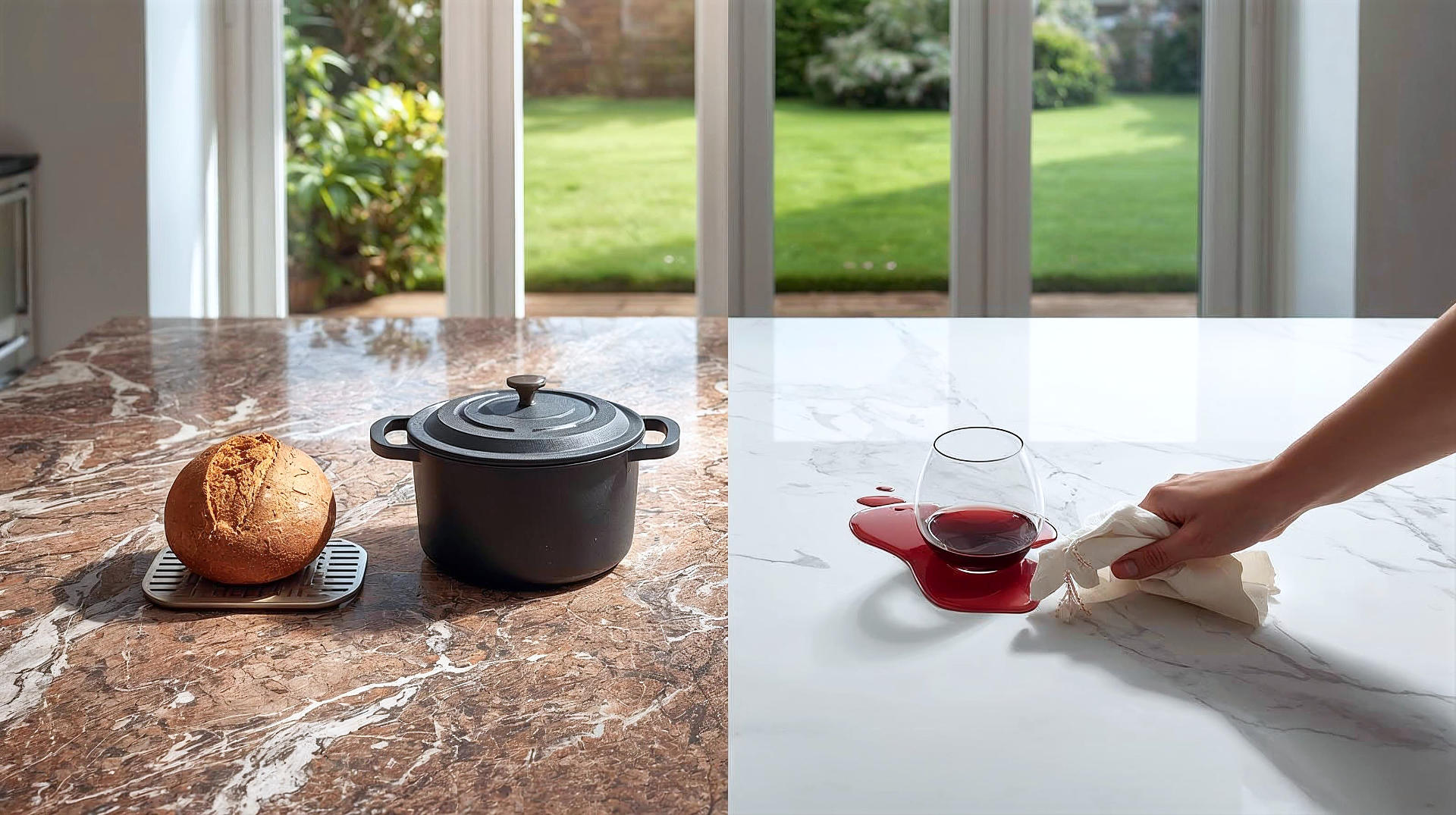
Granite vs Quartz Worktops For Busy Families: Cost, Durability & Best Choice
Choosing between Granite and Quartz? This definitive guide breaks down the battle of the stones...
Jan
A Season of Gratitude: A Christmas Message from MGD
As 2025 ends, Marble & Granite Designs (MGD) shares a message of gratitude and hope,...
Dec

Beyond the Worktop: Carrara Marble Fire Hearth Installation
A stunning demonstration of MGD’s versatility, taking our precision templating and fitting skills beyond the...
Dec
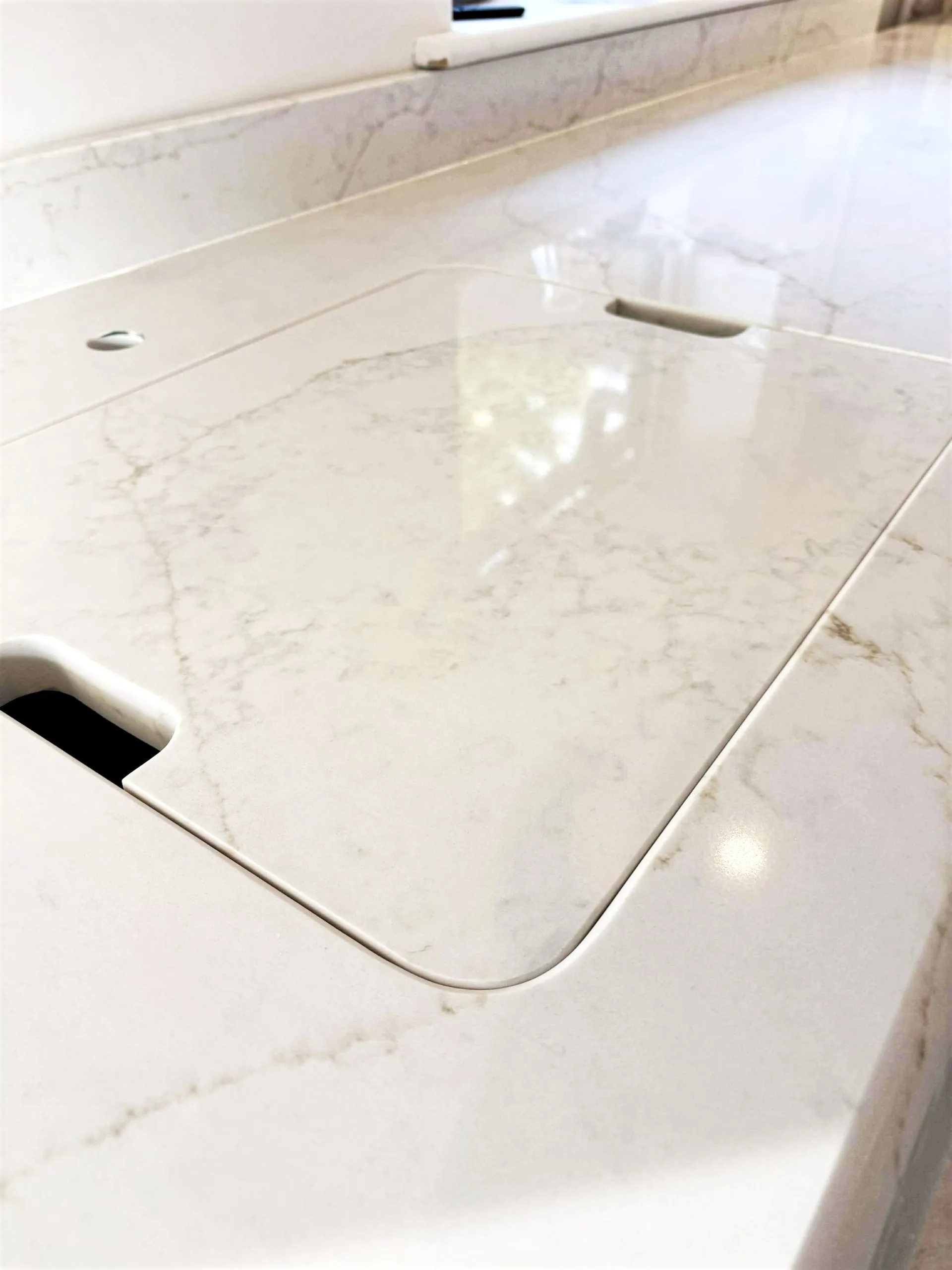
More Than Just a Surface: The Art of the Hidden Sink
Quartz worktops installation with custom hidden sink, blending style and practicality into the perfect modern...
Nov

Quartz Home Bar and Kitchen Worktops
See how we transformed a disconnected kitchen and bar into one cohesive hub. This project...
Nov
Conclusion: The Artisan’s Signature on Your Stone
As you can see, the edge profile of your granite or quartz worktop is a significant detail, a blend of history, artistry, and practical engineering. It’s where our craft as stonemasons truly comes to the fore, transforming a beautiful natural material into a bespoke element of your home. By understanding the stories and characteristics of profiles like the Sharks Nose, Scotia, Ogee, Bullnose, Demi Bullnose, Double Pencil, Single Pencil, Double Chamfer, and Single Chamfer, you’re better equipped to choose an edge that not only looks stunning but also reflects your personal style and enhances your daily life.
We encourage you to discuss these options with us. Let us share our samples, our insights, and our passion. Choosing the right worktop edge is like choosing the perfect frame for a masterpiece – it completes the picture and ensures you’ll cherish your stone for decades to come.
 Concrete-effect
 Granular
 Industrial-effect
 Marble-effect
 Solid Colour
 Stone-effect
 Terrazzo
 Wood-effect
 Natural Granite
 Natural Limestone
 Natural Marble
 Natural Quartzite
 White
White Grey
Grey Black
Black Beige
Beige Brown
Brown Cream
Cream Off-white
 Blue
Blue Gold
Gold Yellow